
Sunset Boulevard in Hollywood is one of the busiest pedestrian corridors in Los Angeles. Tourists, entertainment industry workers, restaurant-goers, and residents share sidewalks that were designed for foot traffic — not for electric scooters traveling at 15 miles per hour. When a scooter crash happens on a Hollywood sidewalk, the first legal question isn’t who was hurt most — it’s who had a legal right to be where they were, doing what they were doing.
California’s scooter regulations are specific about sidewalk use and helmet requirements. When a rider violates those regulations and a crash results, those violations shift fault in ways that directly affect the rider’s ability to recover — and increase the rider’s liability to any pedestrian they struck. If you’ve been involved in a Hollywood scooter sidewalk crash, speaking with our Hollywood scooter injury help team is the right first step to understanding how the regulations affect your specific situation.
What Hollywood Scooter Crash Victims Need to Know About Sidewalk Rules and Fault
Direct Answer: Does Riding a Scooter on the Hollywood Sidewalk Make the Rider Liable for a Crash?
It depends on the circumstances, but sidewalk riding is a significant fault factor. California Vehicle Code § 21235 prohibits motorized scooter operation on sidewalks except to enter or exit adjacent property. In Hollywood and throughout Los Angeles, this prohibition is broadly enforced. A rider who was operating on a prohibited sidewalk when a crash occurred was violating a traffic law — and that violation is relevant evidence of negligence per se under California law. A pedestrian struck by a sidewalk-riding scooter has a strong fault argument based on that violation alone. A rider who was on the sidewalk and was then struck by a vehicle faces the counterargument that their own sidewalk violation contributed to the crash.
What To Do Next: 7 Steps After a Sunset Boulevard Scooter Crash
- Call 911 — a Hollywood police response documents the crash location, the sidewalk or street context, and any witness information. The officer’s report may note whether the rider was on the sidewalk.
- Document your location precisely before moving — photograph the scooter’s position relative to the sidewalk, bike lane, or street travel lane to establish where you were when the crash occurred.
- Photograph any visible injuries immediately and throughout recovery — scooter injuries often include significant road rash and impact injuries that are most compelling when photographed at peak severity.
- Note whether you were wearing a helmet — photograph it if it sustained impact damage. Helmet condition after a crash is evidence of the severity of the head impact.
- Identify and speak to witnesses before they disperse — pedestrians, nearby business employees, and other riders on the corridor are all potential third-party witnesses.
- Seek same-day emergency medical evaluation — head trauma, fractures, and internal injuries from scooter crashes may not be immediately apparent and should be ruled out before symptoms develop.
- Contact a scooter accident attorney before responding to any insurer or platform representative.
California Vehicle Code on Motorized Scooters: What Riders Must Know
California’s motorized scooter regulations establish the framework for where riders can operate and what protective equipment is required. The key provisions that affect Hollywood crash liability are:
Sidewalk Prohibition Under CVC § 21235
CVC § 21235 prohibits motorized scooter operation on sidewalks except when entering or leaving property immediately adjacent to the sidewalk. On Sunset Boulevard, Hollywood Boulevard, and most high-traffic Hollywood streets, sidewalk riding is prohibited. Riders who operate on the sidewalk are not just violating a city ordinance — they are violating state law. That violation constitutes negligence per se in California, meaning a court may instruct a jury that the rider breached a duty of care owed to pedestrians by virtue of the statutory violation alone, without requiring additional proof of unreasonable conduct.
Designated Bike Lane and Roadway Requirements
Where bike lanes are present, scooter riders in California are generally required to use them rather than the sidewalk or the main travel lane. Hollywood’s Sunset Boulevard, Cahuenga Boulevard, and portions of Hollywood Boulevard have designated bike lanes. A rider who chooses the sidewalk over an available bike lane faces a much stronger fault argument than one who was on a road without bike lane facilities.
Our Hollywood team knows the specific street configurations and bike lane installations across Hollywood’s major corridors — a context that matters for the fault analysis in any sidewalk crash case.
California Helmet Law for Electric Scooters
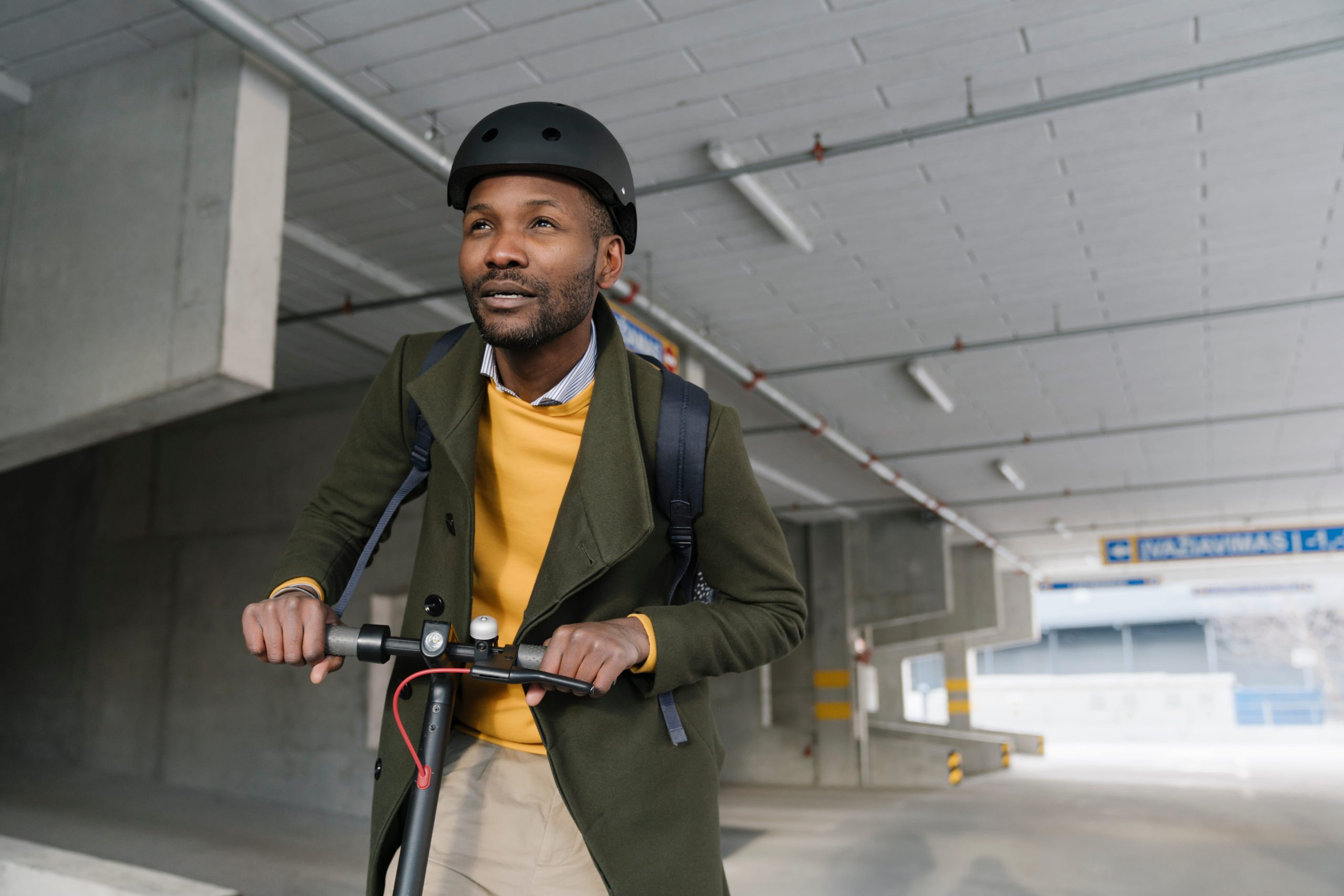
California Vehicle Code § 21235(b) requires scooter riders to wear a properly fitted and fastened bicycle helmet if they are under 18. Adults 18 and over are not required by California state law to wear a helmet while operating a motorized scooter on public roads. However, this state-level rule is nuanced in two important ways.
How Helmet Use — or Non-Use — Affects an Adult’s Injury Claim
Even though California does not require adult riders to wear helmets on public roads, the decision not to wear one can affect a head injury claim under comparative fault principles. An insurer defending a claim involving a serious head injury to an unhelmeted adult rider may argue that the failure to wear a helmet was itself negligent conduct that contributed to the severity of the injury — not the occurrence of the crash, but the degree of harm suffered.
California courts have addressed the helmet question in various contexts. The argument that helmet non-use constitutes comparative fault for injury severity — rather than fault for the crash itself — has been raised in scooter and bicycle injury cases. Whether it succeeds depends on the specific facts and how the argument is framed. An attorney can anticipate this defense and address it through medical expert testimony about injury causation.
Platform Helmet Requirements
Lime and Bird both require riders to wear helmets in their terms of service, regardless of state law requirements. A rider who was not wearing a helmet and is making a claim against the platform faces the additional argument that they breached the platform’s own safety requirements. This doesn’t bar recovery against the platform, but it is a factor the platform’s claims team will raise in any dispute.
Pedestrian Claims After a Sidewalk Scooter Impact on Sunset Boulevard
For pedestrians struck by a scooter on a Hollywood sidewalk, the liability picture is generally favorable. A scooter operator riding on the sidewalk was violating state law. A pedestrian on a sidewalk was exactly where they had a legal right to be. The combination creates a strong fault argument in the pedestrian’s favor that supports claims for all resulting injuries, including fractures, head trauma, soft tissue injuries, and emotional distress.
The most common pedestrian sidewalk scooter claims on the Sunset Boulevard corridor involve:
- Sudden scooter approach from behind without warning — pedestrians who were struck from behind had no opportunity to avoid the collision
- Scooter riders emerging from business doorways at speed — particularly near nightlife venues and restaurant entrances
- Nighttime crashes with reduced visibility — scooter lighting requirements under CVC § 21235(e) become relevant when poor visibility contributed to the impact
In all of these scenarios, the pedestrian’s own fault allocation is typically minimal. Pedestrians on sidewalks are the most protected category of road users under California law.
When the scooter crash also involves a rideshare vehicle — for example, an Uber driver who opened a car door into a bike lane, causing a scooter to veer onto the sidewalk — the Hollywood rideshare crash coverage structure adds another layer to the liability analysis.
Rider Claims: When a Scooter Rider Injured on the Sidewalk Seeks Recovery
Riders injured on sidewalks face a more complex fault position than pedestrians. If a vehicle struck a scooter that was on the sidewalk, the vehicle driver may still be primarily liable — vehicles are required to yield to pedestrian and scooter traffic in certain crosswalk and intersection scenarios. But the rider’s presence on a prohibited sidewalk gives the driver’s insurer a comparative fault argument that the rider has to overcome.
The strength of that fault argument depends on: whether a bike lane was available as an alternative, the specific location of the crash relative to sidewalk prohibition rules, and whether the rider’s sidewalk position meaningfully contributed to the crash’s occurrence. These are fact-specific determinations that require legal analysis of the specific intersection and road configuration.
When to Talk to a Hollywood Scooter Accident Lawyer
Sidewalk scooter crash liability turns on specific California statutory rules that most injured parties aren’t aware of before they speak to an insurer. Whether you’re a pedestrian struck by a sidewalk rider or a rider who was hit by a vehicle, the fault analysis starts with where each party was — and whether they had a legal right to be there.
Most scooter accident attorneys handle these cases on a contingency basis. Contact us for a free review — or start your free injury case review now.
Frequently Asked Questions:
- Can I be held fully liable for a crash because I was riding on the Hollywood sidewalk?
Not automatically, but sidewalk riding is a significant fault factor. California’s pure comparative negligence framework means that even a partly at-fault rider can recover, with damages reduced by their percentage of fault. However, a sidewalk rider who struck a pedestrian faces a strong negligence-per-se argument and may be found primarily or entirely liable depending on the circumstances. The other party’s conduct — speed, distraction, right-of-way violations — also factors into the final allocation. - What if I didn’t know scooter riding was prohibited on the Hollywood sidewalk?
Ignorance of the traffic law doesn’t eliminate the legal effect of violating it. Negligence per se applies whether or not the rider was aware of the prohibition. Most scooter platform terms of service also specifically require riders to comply with all applicable traffic laws and prohibit sidewalk riding. However, the practical argument about fault allocation can still account for factors like inadequate signage, unfamiliarity with local rules, or ambiguous pavement markings that contributed to the rider’s decision. - What if I was wearing a helmet when I was hit — does that help my claim?
Yes, in two ways. First, it eliminates the helmet-related comparative fault argument that insurers raise against unhelmeted riders in head injury cases. Second, a helmet that sustained visible impact damage is direct physical evidence of the force of the collision — it corroborates the severity of the head impact and supports the injury claim. Photograph the helmet immediately and do not discard or repair it — it is physical evidence. - If a car doored me on Sunset Boulevard and I went onto the sidewalk and hit a pedestrian, am I liable to the pedestrian?
This is a multi-party chain collision scenario. The driver who doored you bears liability for the initial impact and for the foreseeable consequences — including the secondary collision with the pedestrian. You may bear some liability to the pedestrian depending on whether your response to the dooring was reasonable. The pedestrian can pursue both you and the driver. An attorney can help untangle the fault allocation across all parties, and the driver’s insurer is a primary target for the full chain of events. - Does LADOT have specific scooter zones on Sunset Boulevard that affect liability?
LADOT’s dockless scooter program includes designated riding zones and areas where scooters are restricted. These designations are reflected in the operator’s app — some zones are geofenced to limit speed or prohibit riding entirely. If a crash occurred in an area where the platform’s own geofencing should have slowed or stopped the scooter, the platform’s failure to enforce its own operational boundaries is a relevant liability consideration. An attorney can request the platform’s geofencing records for the crash location. - How long do I have to file a Hollywood scooter sidewalk crash claim?
In most California personal injury cases, the statute of limitations is typically two years from the date of the accident. If the crash involved a road condition defect maintained by the City of Los Angeles — for example, a cracked sidewalk or missing curb ramp that contributed to the crash — a government claim must generally be filed within six months. Witness availability and scene evidence degrade well before the legal filing deadline, making early legal contact important.